- Jul 2
Make Double Materiality Practical and Proportionate
- Team @ ESG Made Easy Easy
- Double Materiality
- 0 comments
Side one: impact materiality
How your business affects the world around it – the impact your operations, supply chain, and products have on people and the planet, both positive and negative.
Side two: double materiality
A double materiality assessment looks at both sides at the same time. It gives you a complete, ranked picture of the ESG issues that are significant – either because your business affects them, because they affect your business, or both. This is the foundation of a credible, strategic sustainability position.
For a food manufacturer, for example, impact materiality might surface water usage in the production process and packaging waste as significant issues – things the business is actively contributing to. Financial materiality might surface supply chain disruption from climate events, or the cost of regulation around food labelling and environmental claims. A double materiality assessment shows both, ranked by significance, so you know where to focus.
Why this matters now – even if regulation has not reached you yet
The Corporate Sustainability Reporting Directive (CSRD) is the regulation most often associated with double materiality, and for good reason – it mandates a double materiality approach for all companies within its scope, which covers over 50,000 businesses across the EU. But the relevance of double materiality goes well beyond formal compliance obligations.
If your business supplies to larger companies that fall under CSRD, you will increasingly be asked to provide ESG data as part of their own reporting. Buyers, retailers, and procurement teams are already requesting this information from their supply chains. Investors and lenders are factoring ESG performance into financing decisions. And customers – particularly in the food and agri space – are paying closer attention to where their products come from and how they are made.
The practical reality for SMEs
You do not need to be subject to CSRD to benefit from knowing your material ESG issues. Understanding where your business stands – on your own terms, in a structured and credible way – puts you ahead of the conversation rather than scrambling to catch up when a customer, buyer, or lender asks the question.
Businesses that complete a materiality assessment now are the ones that will answer those questions with confidence. The ones that wait will find themselves working to someone else's timeline, with less control over the narrative.
Why proportionality matters as much as process
One of the most common reasons SMEs avoid materiality assessments is the assumption that doing it properly requires a large investment of time and money. That assumption comes from how the process has traditionally been delivered – through lengthy consultant engagements, complex spreadsheet models, and reports that take months to produce.
That model exists because until recently there was no better option. Pulling together MSCI benchmarking data, mapping ESG issues against global frameworks like GRI, SASB, and ESRS, and producing an audit-ready output genuinely did require significant expertise and manual effort.
"The right materiality assessment focuses your whole organisation on the issues that reduce risk, increase business value, and benefit your stakeholders – without asking you to report on everything."
What has changed is the availability of purpose-built software that automates the analytical heavy lifting – narrowing down 40 or more potential ESG issues to the ones that are genuinely relevant to your business, benchmarking them against industry peers, and producing a structured, credible output that holds up to scrutiny. The process that used to take months can now be completed in hours, at a fraction of the cost.
What a practical, proportionate assessment looks like
A materiality assessment that is practical and proportionate for an SME is one that focuses on what genuinely matters to your business and your stakeholders – and nothing else. It is not about producing the longest possible report or mapping every conceivable ESG issue. It is about building a clear, defensible picture of where your business stands.
What a well-run materiality assessment delivers
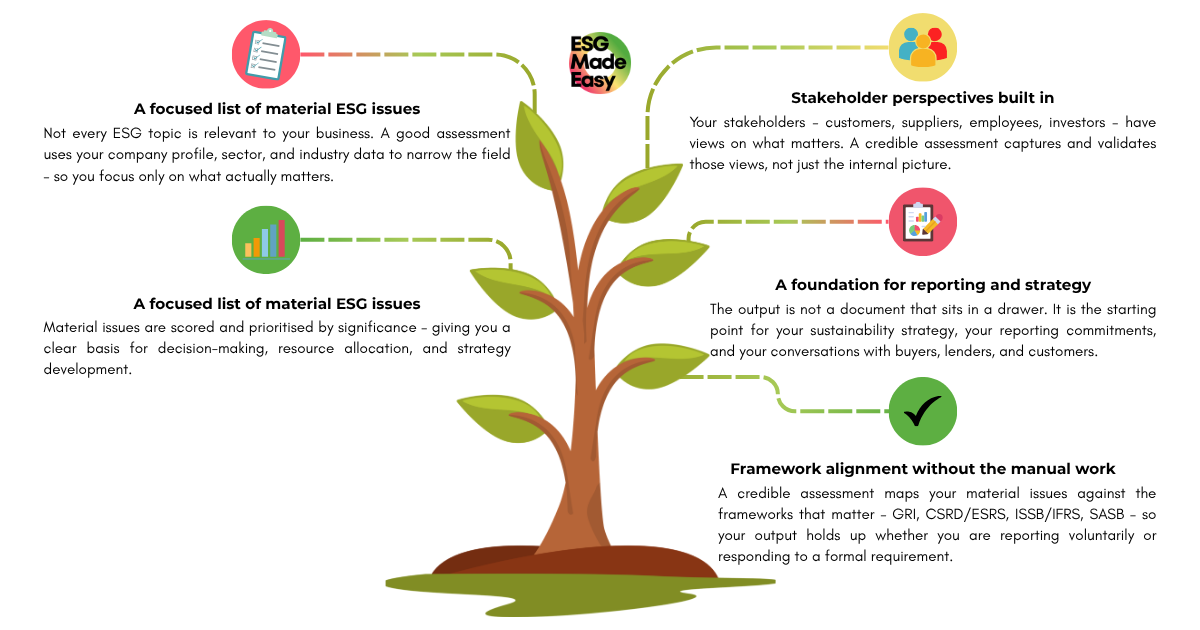
This is exactly what Drova's RunSustainably platform is built to deliver. A team of specialist AI agents, called AI Mates, profile your business using MSCI benchmarking data, surface the ESG issues most relevant to your sector and size, and guide you through both sides of the materiality picture in a structured, auditable process. The output is a comprehensive materiality report: specific to your business, credible to your stakeholders, and ready to form the foundation of your sustainability strategy. If you need it, the same platform connects your materiality output to risk, compliance, and resilience.
As a Drova partner, we work with businesses to make this process as smooth and as useful as possible – bringing the human context and strategic guidance that helps you get the most out of the platform, and making sure the output connects directly to your business goals.

Ready to understand what really matters to your business?
We work with SMEs in food, agri, hospitality, and manufacturing to complete their materiality assessment using Drova's RunSustainably platform – a structured, practical approach that delivers a credible result without the cost and complexity of a traditional consultant-led process.
Contact the team at ESG Made Easy to find out how we can help you get started.
ESG Made Easy: Why Sustainability Matters
The plain-language guide to ESG for business leaders.